Explore the most beautiful bridal hairstyles for 2026, including buns, braids, updos, and romantic wedding hair look for every bride and hair type.
There is a version of bridal hair that exists purely to be unimpeachable. It is smoothed until nothing moves, pinned until nothing escapes, and finished until it looks less like hair and more like an object placed on top of a head. It asks nothing of the woman wearing it and receives nothing in return — no personality, no texture, no sense that this is a person who has ever had an interesting relationship with her own hair. It is safe in the way that only things with no point of view can be. In 2026, that version of bridal hair has been retired.
The bridal hair story of this season is built on the idea that a wedding style is a portrait, not a performance. It should look like the woman wearing it on the best, most considered version of herself — not like a category of hair labelled bridal that could belong to anyone. The styles dominating 2026 are precise where precision is necessary and deliberately imperfect where imperfection is more beautiful than control. They reward a trial appointment that goes deeper than choosing between up and down. They reward the conversation that asks what the woman’s hair actually does when it is left to itself, and builds the style from that answer rather than against it.
What makes 2026’s bridal direction particularly compelling is the way the season has resolved the tension between occasion and identity. The styles that matter most this year are neither stiff and overly formal nor so casual they read as underdressed for a wedding. They occupy the precise space between those poles — elevated enough to carry the weight of the occasion, personal enough to look like a choice rather than a concession to what bridal hair is supposed to be. A chignon that has texture rather than polish. Waves that are set rather than curled-and-hoped-for. A veil-compatible updo that still has the ease of something the wearer could have done herself on a remarkable day.
The accessory is not an afterthought in 2026. It is part of the design — and every style on this list has been considered in relation to what sits beside, beneath, or above it.
This guide covers eight of the most beautiful bridal hair styles for 2026 — each explored in full so you understand not just what the look is, but how it is built, worn, and made to feel entirely like the woman it belongs to.
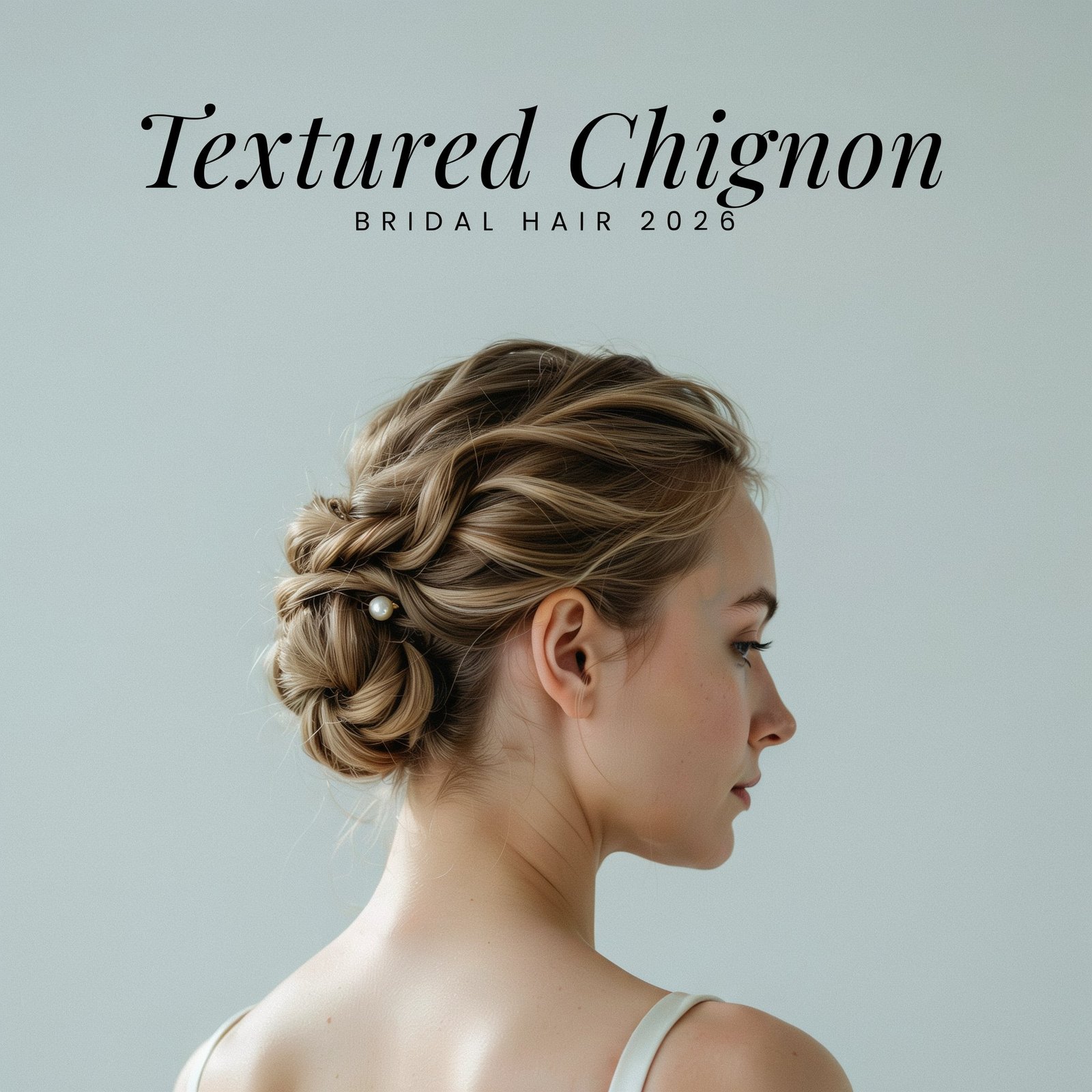
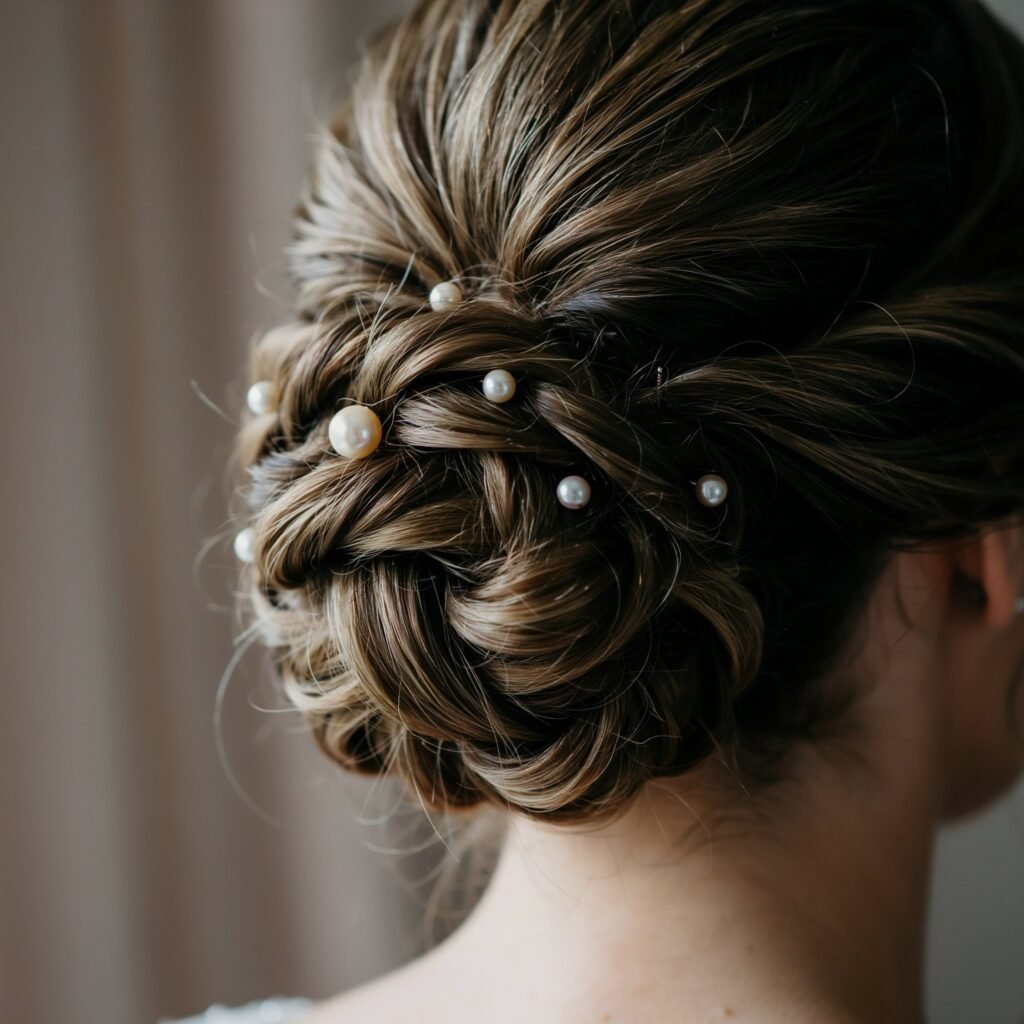
1. The Textured Chignon — The Updo That Has Finally Found Its Personality
The textured chignon is 2026’s most elegant bridal statement and its most technically considered updo. It sits at the nape — the classic chignon placement — but it is built with a surface quality entirely unlike the smooth, lacquered versions that have defined the style for years. The 2026 textured chignon has visible movement in its construction: sections that catch the light differently, twists that are slightly separated rather than sealed flat, and a finish that reads as refined rather than rigid. It is a chignon that looks like hair, which is both the simplest description and the most radical departure from what bridal chignons have historically been.
Why the 2026 textured chignon is different from what came before:
The surface is built rather than smoothed — sections are twisted and pinned with deliberate imprecision, so the texture is part of the construction rather than something that needs to be corrected The volume is distributed through the chignon itself rather than being backcombed into the crown, which gives the style its elevation without the stiffness that volume-heavy updos can produce It holds a veil without competing with it — the textured surface gives pins and combs something to grip, and the natural variation in the style’s surface allows the veil to sit as part of the look rather than as a separate element placed on top
How this style is built:
Prep with a texturising spray on dry hair or set the hair in large pin curls the night before — the texture needs to be in the hair before the style is built, not applied to it afterward Take sections and twist each one before directing it toward the nape, pinning as you go with a deliberate looseness — the sections should hold without being sealed Build the chignon at the nape by coiling the twisted sections around each other, securing with pins and leaving fractional gaps in the surface Do not smooth the outline — the wisps and the variation at the perimeter of the chignon are what give the style its 2026 identity Finish with a light-hold hairspray that sets without flattening
Who the textured chignon works for:
Medium to long hair at almost any texture. It is particularly transformative on fine hair that has always found sleek updos difficult to maintain — the texture and the distributed pinning of the 2026 version hold through an entire day in a way that smooth chignons typically cannot.
Accessory pairings:
A pearl or crystal pin worked into the body of the chignon — the texture catches and holds it without a separate comb A simple veil attached at the centre of the chignon — the textured surface grounds it beautifully A low, delicate headband sitting just above the nape, framing the chignon from above
2. The Romantic Loose Wave — The Bridal Down Style That Earned Its Place
The romantic loose wave is 2026’s most enduring bridal down style — and it earns its permanent position this season by becoming something technically specific rather than simply hair worn down with some effort applied to it. The 2026 romantic loose wave sits at whatever length the bride has, is set with a large-barrel iron or a roller set rather than a curling wand, and is finished so that the wave is visible and defined but not rigid. The difference between a loose wave that reads as bridal and one that reads as underprepared is entirely in the setting technique and the finishing — and in 2026, that technique has been refined to the point where the result is unmistakable.
What makes the 2026 romantic loose wave different from previous iterations:
The wave is set, not styled — the distinction matters enormously; a set wave has a memory that holds through a full day and into the evening, where a curled-and-brushed wave does not The movement comes from the root, not just the ends — sections set from close to the scalp create a wave that has volume and direction throughout, not just texture at the mid-lengths and below It is finished with separation rather than smoothing — fingers through a set wave after it has cooled creates softness and dimension; a brush creates a blowout, which is a different style
How this style is built:
Set the hair in large sections on a wide-barrel iron, directing alternate sections in opposite directions — this is the technical foundation that makes the wave look natural rather than curled Allow every section to cool completely before touching — this step is non-negotiable; touching warm hair breaks the set before it has formed Once cool, take each section between the fingers and gently separate — no brush, no comb, just fingers working through the wave to create softness without destroying the shape Finish with a light serum through the lengths for gloss and a medium-hold spray for longevity Face-framing pieces should be separated last and given the most attention — these are the waves that read closest to the face and carry the most visual weight
Who the romantic loose wave works for:
Any length from the collarbone downward. On shorter hair, the wave creates texture and movement rather than the long romantic fall, which is a different effect — equally beautiful but a different style. This is the bridal down style for hair that has genuine length to work with.
Accessory pairings:
A floral or pearl pin placed asymmetrically within the waves — not centred, not symmetrical, just present A delicate vine or chain headpiece sitting back from the hairline, so the waves fall forward around it A cathedral or chapel veil worn loose over the waves — the most classically bridal combination and the one the 2026 romantic loose wave does best
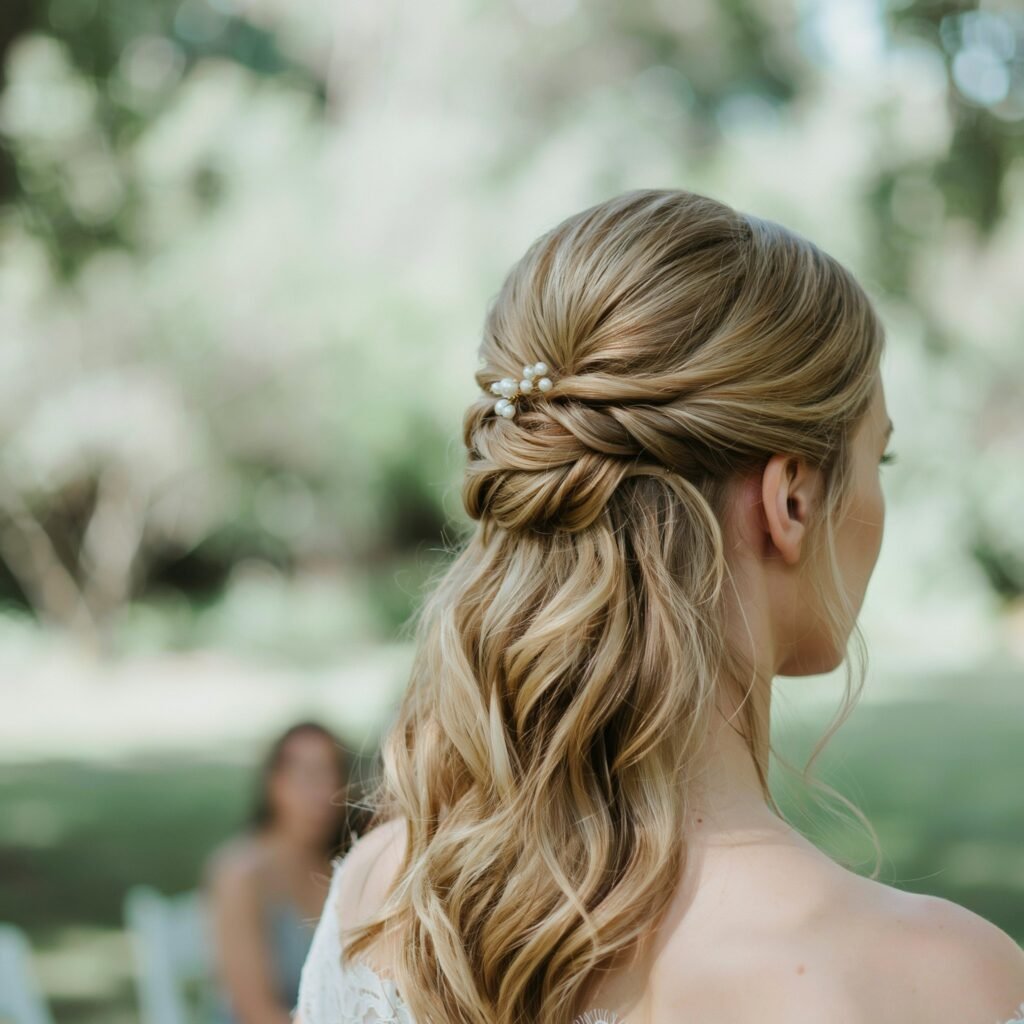
3. The Sculptural Half-Up — The Style That Resolves Every Debate
The sculptural half-up is 2026’s answer to the half-up question, which has historically produced results that are neither properly up nor properly down — a compromise that satisfies neither ambition. The 2026 version resolves this by treating the upper section as a genuine style in its own right: a knot, a twist, or a gathered shape that has sculptural quality rather than simply being hair that has been pulled back and secured. The lower section is not an afterthought but a complement — worn in waves, in natural texture, or in carefully considered movement that works with whatever shape has been built above it.
Why the sculptural half-up is the bridal style of 2026:
Its upper section is a design decision rather than a concession — the knot or twist is built with the same care as a full updo, so the style reads as complete rather than unfinished It accommodates virtually every accessory — a veil can be worn beneath the upper section, a pin or comb can be worked into the sculptural element itself, or the style can stand entirely alone It grows well through the day — the lower section moves and the upper section holds, so the style at the end of the evening is a relaxed version of itself rather than a collapsed one
How this style is built:
Take the upper section — from the temples to the crown, no further — and separate it cleanly from the lower section Twist the upper section once or twice and form it into a knot or a gathered shape at the centre back of the crown, securing with pins from the inside so no pins are visible on the surface The shape should have dimension — not flat against the head, but lifted fractionally at the centre for the sculptural quality that defines the style The lower section is prepared separately: set in waves, diffused for natural texture, or blow-dried for movement, depending on the bride’s preference and hair type The join between upper and lower sections should be clean but not severe — a few face-framing pieces pulled forward from the upper section soften the line
The sculptural half-up spectrum:
Classic sculptural half-up — a clean knot or twist at the crown, lower section in waves, the most balanced interpretation Romantic sculptural half-up — a looser, more gathered upper shape with more texture in the lower section Minimal sculptural half-up — the smallest possible upper section, almost hidden within the lower section, for the bride who wants the structure with the least visibility
Accessory pairings:
A single statement pin or jewelled comb worked into the sculptural upper section A blusher veil attached at the crown, sitting behind the upper section A delicate wreath or crown of flowers or pearls sitting just above the sculptural element
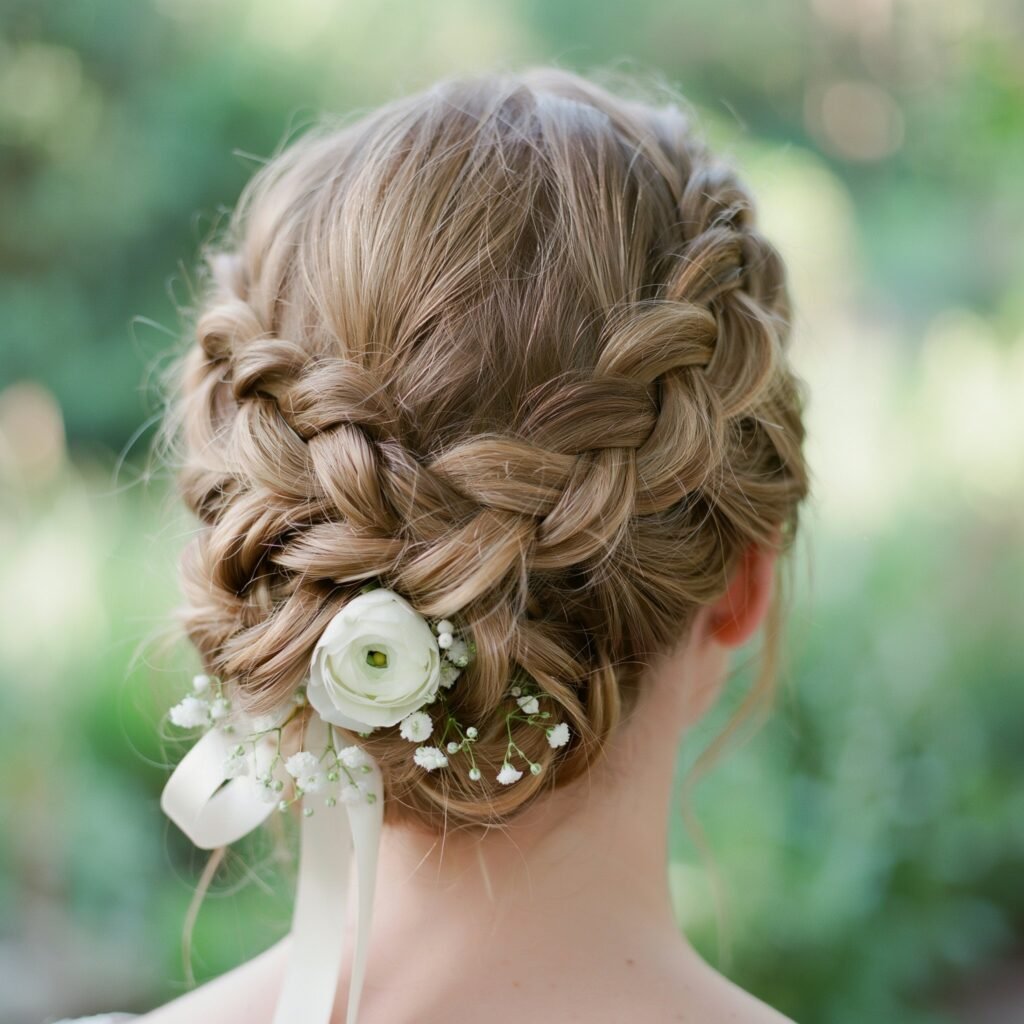
4. The Undone Braid — The Bridal Plait That Left Perfection Behind
The undone braid is summer 2026’s most romantically imperfect bridal style — and it earns its position this season by becoming something more considered than the pulled-apart fishtail that has been circulating for several years. The 2026 undone braid is specific about where its imperfection lives: the texture is pulled out deliberately and in specific places, the loose pieces are chosen rather than random, and the overall effect is of a braid that has been lived in for exactly the right amount of time rather than constructed to look as though it has been. There is a meaningful difference between a braid that is undone and a braid that is unfinished, and the 2026 version is entirely the former.
What distinguishes the 2026 undone braid from its predecessors:
The texture is introduced at the top and through the body of the braid, not just at the ends — pulling sections from the crown gives the style volume and a loose, gathered quality that end-only texture cannot produce The braid type is specific this season — a Dutch braid or a relaxed three-strand plait worked loose, rather than a fishtail, which tends to look more effortful and less bridal in its undone state The face-framing pieces are set before the braid is built — they are not leftover sections that didn’t make it in, but deliberately prepared pieces that have been waved or curled before being left out
How this style is built:
Prep with a texturising spray and rough-dry for grip — this is not a style that should be built on freshly washed, slippery hair Prepare the face-framing sections first: set them with a small barrel iron and set aside Braid the remaining hair in whichever technique suits the look — a Dutch braid for more structure, a loose three-strand plait for the most relaxed version Once the braid is secured, pull sections from the top and sides with a pin or the tip of a tail comb — small amounts at a time, working from the crown downward until the volume and looseness feel right Finish the face-framing sections with a light serum and allow them to fall forward naturally
Who the undone braid works for:
Long hair, ideally to the mid-back or longer, so the braid has enough length to carry its looseness without looking too small. On medium-length hair, the undone braid is better as a side braid or as a braided half-up element than as a full back braid.
Accessory pairings:
Flowers — fresh or dried — worked into the braid at intervals for the most romantic bridal version of the style A low, simple veil worn beneath the braid at the nape A delicate gold or pearl pin at the base where the braid meets the nape
5. The Sleek Low Bun — The Architectural Bridal Updo
The sleek low bun is 2026’s most quietly powerful bridal style. It sits at the nape — not the textured chignon’s territory of movement and variation, but the polar opposite: smooth, close, and completely controlled. Every hair directed. Every edge considered. The sleek low bun is the bridal style that reads as completely certain of itself, and in a season of romantic imperfection and deliberate texture, its precision is the counterpoint that makes it compelling. It is the style that requires the most technical execution and produces the most unambiguous result.
Why the sleek low bun is compelling in 2026:
Its clarity of surface creates a visual authority that textured and romantic styles cannot replicate — the light travels across the gathered sections in a single, unbroken movement Against the softness of the season’s other bridal styles, it reads as the sharpest possible statement — a bride who knows exactly what she wants and has executed it with complete precision Its simplicity makes every accessory more visible — a single pair of statement earrings, a delicate hair pin, or a cathedral veil worn behind it all read more clearly against the clean surface of this style
How this style is built:
Blow-dry the hair completely smooth before building the style — the smoothness has to begin at the preparation stage, not be applied to the surface afterward Apply a smoothing cream or gel through the lengths before gathering — the product applied before, not after, prevents the surface from lifting through the day Gather at the nape and secure with a soft, strong elastic — the position should be low and centred, precisely at the nape Wrap the length around the base, tucking and pinning from underneath so no pins are visible on the surface Smooth the surface of the bun with a fine-toothed comb and a light pomade, working any variations flat The edges at the hairline can be smoothed entirely or left fractionally natural — both are valid, and the choice belongs to the bride
Accessory pairings:
A long, fine veil attached at the centre of the bun — the smooth surface gives the attachment point a clean, precise look Statement earrings — the sleek low bun is the style that frames the neck and ears most completely, and it makes jewellery more visible than any other bridal updo A single jewelled pin placed at the base of the bun, just above the nape
6. The Bridal Curtain Fringe — The Face-Frame That Changes the Wedding Portrait
The bridal curtain fringe is not a new idea. It has been present in wedding photography for several years, worn by brides who wanted something different from the pulled-back, face-clear aesthetic that formal bridal hair has historically demanded. What makes 2026 its defining season is the refinement of how it is cut and how it sits within a bridal context — long enough to part softly in the centre and sweep to each side, heavy enough to genuinely frame the face and change how the bride reads in photographs, and calibrated to work with every possible updo or down style the rest of the hair might take. The bridal curtain fringe is not an addition to the wedding hairstyle. It is the element that makes the hairstyle specifically hers.
Why the bridal curtain fringe is the bridal detail of 2026:
It changes the wedding portrait in a way that no other single element can — the face-framing quality of a well-executed curtain fringe is visible in photographs even when the hair itself is in an updo or otherwise not the dominant visual element It grows out gracefully through the engagement period and the honeymoon, which means committing to it for the wedding is committing to something that has a future rather than just a single occasion It works with every style on this list — worn forward within loose waves, swept back within an updo, framing a braid or a half-up shape — the fringe is the consistent bridal identity through every style variation
How this fringe is built for a bridal context:
Cut to the brow or fractionally below — long enough to part softly, short enough to read as a genuine fringe rather than simply long face-framing lengths Point-cut through the perimeter for softness — a blunt fringe edge fights the curtain shape and reads too heavy in a bridal context Blend into the sides with particular precision — on a wedding day, the fringe will be closely photographed from every angle, and a visible blending line is more legible than in everyday wear Style forward and then swept to each side with a round brush, finishing with a very small amount of styling balm to prevent separation
Accessory pairings:
A headband or vine sitting behind the fringe — the fringe frames the face forward of the accessory, which creates a layered, dimensional quality A veil attached at the crown, sitting behind the fringe so both elements are independently visible No accessory at all — the curtain fringe, on the right face, is its own accessory
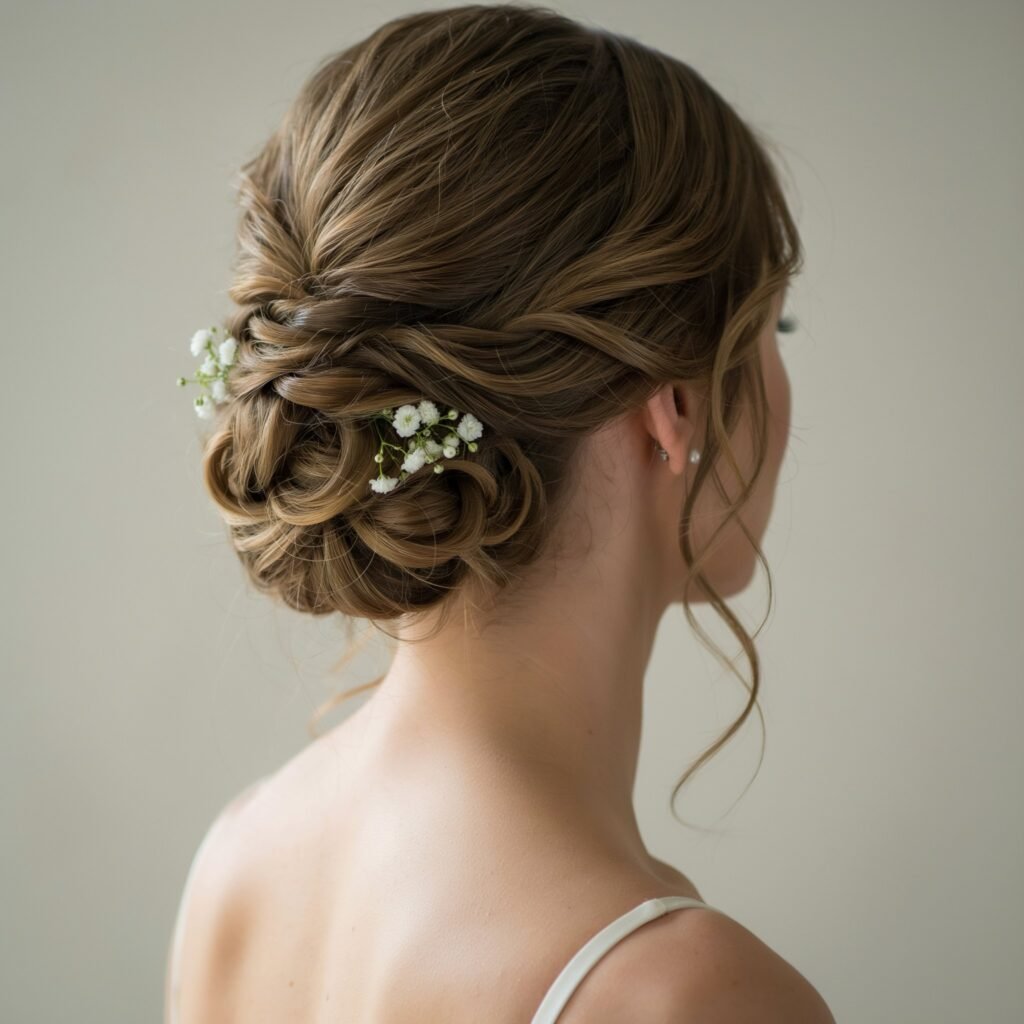
7. The Soft Updo With Tendrils — The Bridal Classic Reinvented
The soft updo with tendrils is 2026’s most universally flattering bridal style — and the season’s most honest acknowledgement that some bridal ideas are perennial because they are correct. This is not a style that has been reinvented for novelty. It is a style that has been refined to the point where its execution in 2026 is meaningfully different from how it has been worn in previous years: the updo is less structured, the tendrils are more deliberately placed, and the overall effect is of something that has the ease of a style the wearer has worn before and the elevation of a style that has been built specifically for this day.
What distinguishes the 2026 soft updo with tendrils from earlier interpretations:
The updo itself is soft — gathered, twisted, and pinned without the rigidity of a formal French twist or a sealed chignon, so the shape has movement within its structure The tendrils are set before they are released — curled with a small barrel and allowed to cool, then released into their position, so they hold their shape through the day rather than drooping by the ceremony’s end The placement of the tendrils is considered: typically two at the temples, one or two at the nape, and occasionally a single piece behind one ear — not more, not symmetrically identical on each side
How this style is built:
Set all tendril sections first — curl tightly with a small barrel iron and pin each one flat until it has cooled completely and set Build the updo with the remaining hair: gathered softly, twisted into a relaxed shape at the centre or side back of the head, and pinned with the same deliberate looseness as the textured chignon Once the updo is secured, release the tendril sections one by one — unpin each curl, allow it to spring open, and position it with a pin if necessary The join between the updo and each tendril should be seamless — no visible line, no abrupt transition from structured to loose Finish with a medium-hold spray that sets without making the tendrils stiff
Accessory pairings:
Flowers tucked into the updo — one or three, always an odd number, for the most natural placement A blusher veil worn over the face and attached at the crown, sitting within the updo A simple, fine headband worn across the top of the head, sitting behind the tendrils at the temples
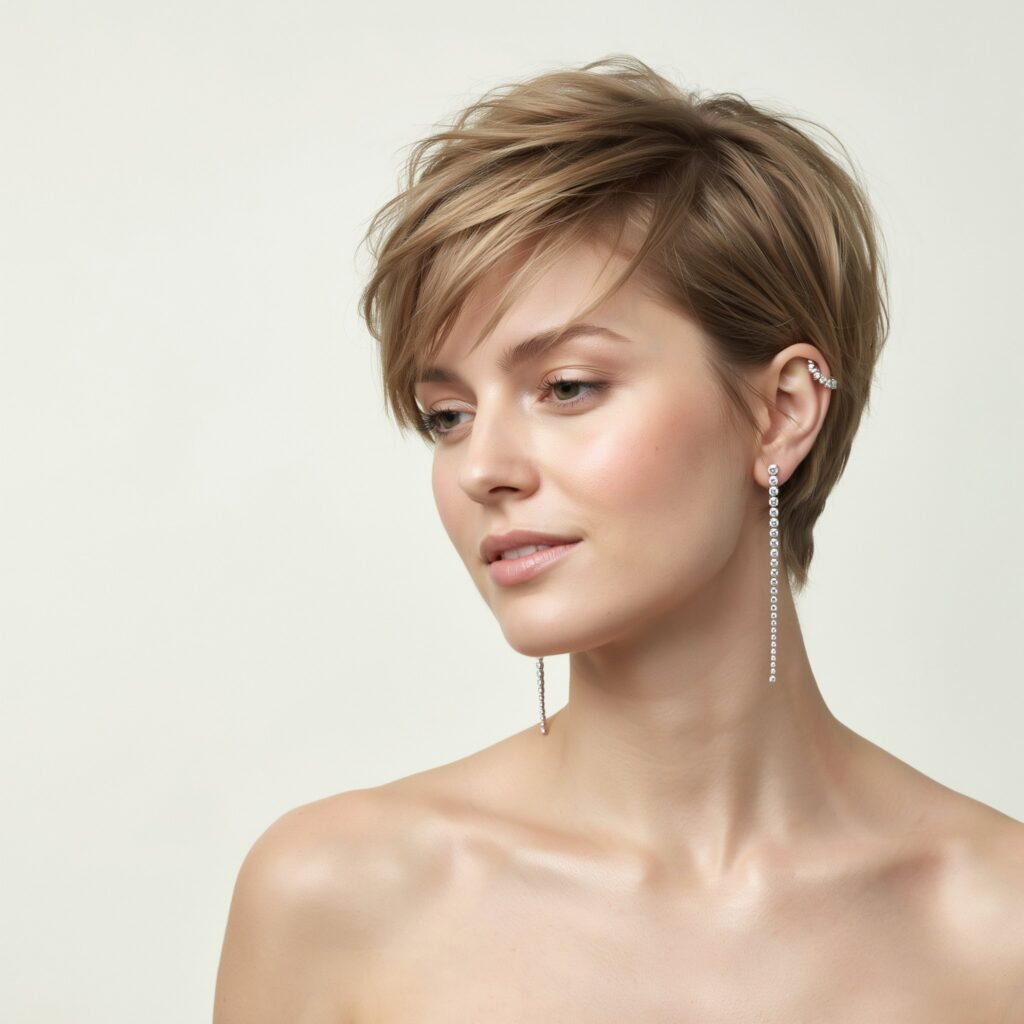
8. The Bridal Pixie Moment — The Short-Hair Wedding Style With Full Authority
The bridal pixie moment is 2026’s most decisive wedding style statement — and the season’s most powerful argument for short-haired brides to approach their wedding day without compromise. This is not a short style that has been dressed up to approximate what longer bridal hair might achieve. It is a short style that has been considered entirely on its own terms: textured through the top for movement and personality, finished with precision at the edges, and accessorised with the specific pieces that make short bridal hair read as a complete and deliberate aesthetic rather than simply the hair the bride happened to have. In 2026, the short-haired bride is not making the best of it. She is making the most of it.
Why the bridal pixie moment is the short-hair statement of the season:
Its personality is the asset — the texture and the movement through the top of a well-executed bridal pixie carry more individual identity than a smoothed updo could on any length of hair The neck and jaw are completely open, which is the most significant difference between short and long bridal hair in photographs — the entire face, neck, and décolletage read without interruption Accessories carry more visual weight on short hair than on long — a pair of exceptional earrings, a delicate hairpin, or a short veil worn at the crown of a pixie reads with a clarity that long hair can diffuse
How this style is built for a bridal context:
Ensure the cut is fresh — a bridal pixie should be trimmed no more than one week before the wedding so the edges are completely precise Apply a light styling cream through the top sections while damp and rough-dry for texture — this is the preparation that gives the style its movement and prevents the flat, lacquered finish that makes short hair look formal rather than considered Once dry, work a very small amount of a light pomade or wax through the top with fingertips — directing the sections with intention, not smoothing them flat Edges at the hairline should be clean and precise — this is the detail that elevates the bridal pixie from casual to considered, and it requires a fresh cut to execute correctly
Accessory pairings:
Drop earrings — the longer and more elegant the better; the open neck of the short bridal style makes long earrings the most impactful jewellery decision a bride can make A small, delicate veil worn at the crown and swept to one side — the least structured veil works best, so the attachment point reads as a decorative decision rather than a structural necessity A single jewelled or floral pin placed at the temple — one pin, deliberately positioned, is the correct amount
The Principles Behind Every 2026 Bridal Style
Three ideas run through every style on this list and are worth understanding before the trial appointment.
The style should look like the bride, not like bridal hair. Every style on this list has been built on the specific premise that the most beautiful wedding hair is the hair that looks like the woman wearing it — not the hair that looks like it belongs to a wedding. This requires a deeper conversation at the trial than “what does the dress look like” or “up or down.” It requires understanding what the bride’s hair does naturally, what she feels most like herself in, and what the day’s conditions will demand. The answer to those three questions is a more useful brief than any reference image.
The trial is where the style is made, not chosen. Choosing a style from an image is the beginning of the process, not the end of it. The trial appointment is where the specific version of that style — the one that works on this hair, for this face, with this accessory — is built. Brides who come to their trial with an image and leave with a faithful reproduction of it have missed the most valuable part of the process. Brides who come with an image and leave with something that looks entirely like them have used the trial correctly.
Longevity is part of the brief. Every style on this list should look as beautiful at the end of the reception as it did at the ceremony. The styles that fail at weddings are always the styles that were not built for the full duration — smoothed into rigidity rather than set for hold, pinned with too few pins in too visible positions, or finished with products that give an hour of perfection and three hours of collapse. A bridal style that looks its best at the end of the evening, slightly lived-in and entirely itself, is a better bridal style than one that looks perfect in the getting-ready photograph and nowhere else.
The Style Is the Portrait
On a wedding day, the hair is in every photograph. It is in the getting-ready images, in the ceremony, in the portraits, in the reception, and in every candid taken between. It is the most consistently present visual element of the bride’s appearance across the entire day, which means that the conversation about what it should be is one of the most consequential conversations in the entire planning process — and one that deserves the same attention, the same research, and the same clarity of intention as every other element.
In 2026, that conversation is being had with more honesty and more specificity than it has been in years. The result is a season of bridal styles that look like real women on their most beautiful days — considered, personal, and completely impossible to mistake for anyone but the woman wearing them.
Bring the specificity to the trial. Know the style, the texture, the accessory. Know whether the day demands a chignon or demands a wave. Know what your hair does and decide whether to build from that or against it — and know that in 2026, every style on this list has been built from it.
For Bridal Makeup check this link. https://womenwearz.com/bridal-hair-styles-2026-the-most-beautiful-wedding-hair-looks-defining-the-season/